
Home › Learn › Travel & Maintenance
The Maintenance PhaseKeeping your routine on the road
Ask people who regained weight after a GLP-1 where things started to slip, and travel comes up constantly. Airports, hotel breakfasts, client dinners, time zones — the road is engineered to break routines. But most travel failures are logistics failures, and logistics can be planned. Here's how to keep a maintenance routine intact away from home.
Why travel breaks maintenance routines
It's rarely one dramatic lapse. It's friction: medication that needs a fridge you don't have, supplies buried in a checked bag, a dose schedule pegged to a time zone you left yesterday. Every point of friction makes skipping easier than following through — and many patients report that a "just this trip" pause quietly becomes a permanent one. The goal isn't discipline on the road; it's removing the friction before you leave.
The refrigeration question
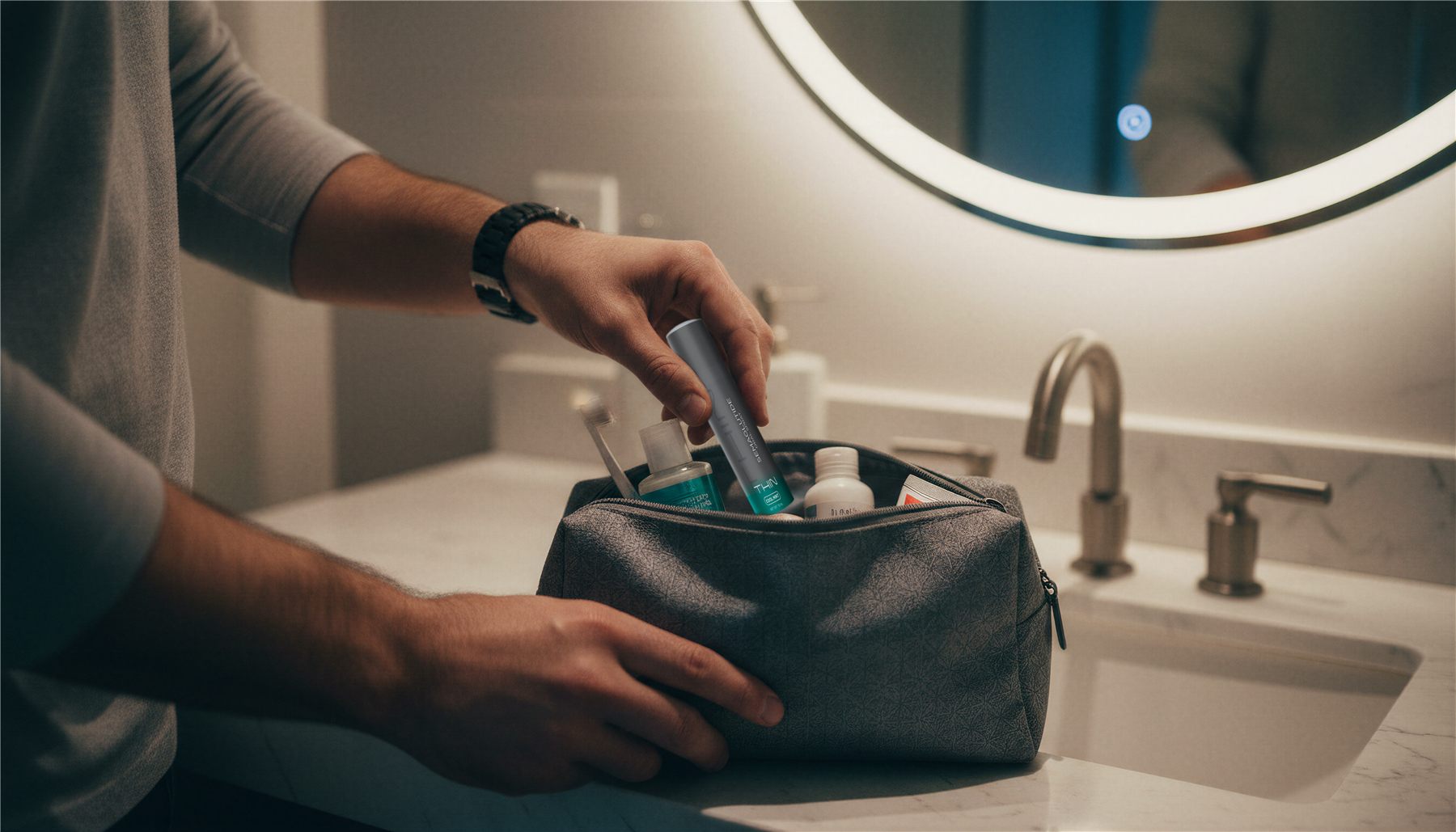
Injectable GLP-1 medications typically require cold storage, which turns every trip into a cold-chain problem: gel packs, insulated cases, hotel mini-fridge roulette. If your maintenance plan involves medication, this is worth raising with your provider directly. Some maintenance-phase options — including prescription-only compounded sublingual sprays like THIN™, which are not FDA-approved and are dispensed only if a licensed provider determines they are appropriate — are designed to be stored at room temperature. Always follow the storage instructions on your specific medication's label, and ask your pharmacy about temperature limits before you travel.
Packing and security lines
- Carry-on, always. Never put medication in a checked bag — bags miss connections, and cargo holds have temperature swings.
- Keep it in original packaging. The pharmacy label with your name on it answers most questions before they're asked.
- Know the liquid rules. TSA permits medically necessary liquids beyond the 3.4-ounce limit, but declare them for inspection. A small spray bottle typically fits inside a standard quart bag anyway, which keeps things simple.
- Pack a buffer. Bring a few days' extra supply for delays and cancellations, and photograph your prescription label in case anything is lost.
- Crossing borders? Check the destination country's rules on bringing prescription medication in, and carry documentation from your provider.
Time zones and dose timing
Consistency matters more than the clock. If your routine is daily, a common approach is to anchor it to a daily event rather than an hour — first thing after waking, or with your morning routine — so it travels with you across time zones. For anything beyond a small shift, ask your provider how they'd like you to handle the transition rather than improvising.
Keeping the rest of the routine alive
Medication logistics are only half of a maintenance routine. The other half — food, movement, tracking — needs travel-proofing too:
- Hold one anchor meal. You can't control every restaurant menu, but you can usually control breakfast. Keep it protein-forward and consistent.
- Walk the trip. Airports, city blocks, hotel stairs — travel offers movement if you take it. A step goal is easier to keep on the road than a gym habit.
- Don't pause tracking. Skip the scale if you must, but keep noting appetite and portions. Trips are exactly when early drift starts.
- Plan the re-entry. Decide before you leave what day-one-home looks like: normal weigh-in, normal meals, no "recovery week."
If needle-and-cold-chain logistics are part of what makes travel hard, it may be worth understanding how needle-free sublingual sprays work — and whether a provider thinks one fits your maintenance plan.
Important safety information
- • This article is educational only and is not medical advice. Always consult a licensed healthcare provider about starting, stopping, or changing any medication.
- • THIN™, THIN-R™, and THIN-ST™ are prescription-only compounded medications, prepared by licensed 503A pharmacies. They are not FDA-approved, and are dispensed only if a licensed provider determines they are medically appropriate.
- • Payment does not guarantee a prescription. Individual results vary.